Last week I had the distinct pleasure of co-hosting the weekly #LeadFromWithin tweetchat with Lolly Daskal. The subject of my chat was “The Role of Empathy in Leadership” and I have to say I was gratified by both the level of participation and depth of contributions/insights which arose during the discussion (click here to download a PDF copy of the chat transcript).
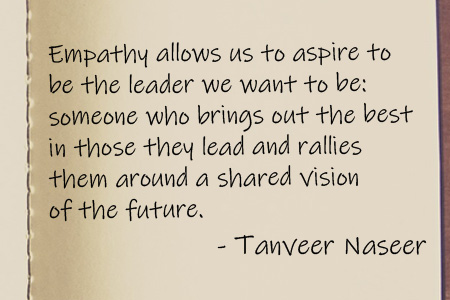
Although I’ve written previously about the importance of empathy in leadership, I want to use last week’s talk as an opportunity to delve into this issue more, sharing some of the points I provided during the talk, as well as some of the insights proffered by the various participants. Here are the ten questions I asked participants as we discussed the role empathy plays in leadership.
1. What does empathy mean?
“Empathy means I demonstrate concern for & listen to reach understanding of others ideas & feelings.” – @scedmonds
In order to appreciate the role empathy plays in leadership, we first need to have a clear understanding of what empathy means. Most times, we tend to confuse empathy with sympathy; that to be empathetic means agreeing or relating to the feelings another person has regarding a given situation or individual.
However, what empathy really means is being able to understand the needs of others. It means that you’re aware of their feelings and how it impacts their perception. It doesn’t mean you have to agree with how they see things; rather, being empathetic means that you’re willing and able to appreciate what the other person is going through.
2. Why does it matter for us to understand the needs of others?
“By understanding others we can develop closer relationships.” – @TerriKlass
At first glance, this might seem a tad altruistic, but there are tangible benefits that are derived from Click here to continue reading »”Empathy in Leadership – 10 Reasons Why It Matters”
If you enjoyed this piece, I'd like to invite you to subscribe to my blog. Just click on the link below, enter your name and email address, and you'll get my latest posts set directly to your inbox -
Subscribe to my blog via email
They say that March comes in roaring like a lion and that certainly seems to be the case on my end as I have two exciting news items to share with my readers.
First up, I’d like to share the news of a new column called “Real Leadership” which I’ll be co-writing with S Max Brown for Incentive magazine. Our first piece can be found in this month’s issue and it’s called “Real Leadership: The Power of a Compliment”. You can read an online version of this column at this link. I’d like to thank Max for inviting me to join him in yet another co-writing venture.
The second news piece is my interview on the “Business Buzz” radio program, hosted by Susan T. Spencer, which can be heard on “WomensRadio”. The show is called “Something That Women Have and Men Want” where Susan and I discuss the importance of empathy in business and leadership. During this interview, I share 3 key steps leaders can take to build their sense of empathy to become a more effective leader.
You can listen to this interview in the player below, or you can listen to it on the “WomensRadio” website by clicking on this link.
Audio clip: Adobe Flash Player (version 9 or above) is required to play this audio clip. Download the latest version here. You also need to have JavaScript enabled in your browser.
I’d like to thank Susan for inviting me to share my thoughts on this subject and for the interesting discussion on this issue.

Which personality type is best suited for leadership – the extroverted or the introverted? It’s a question that surfaces every now and then in discussions on leadership, often with the consensus that while an extrovert would appear to have an easier time leading others, introverts also have unique attributes which prove to be of benefit to those in leadership positions. Now, thanks to a recent study by Adam Grant, Francesca Gino and David Hofmann, we have tangible evidence that there are situations and team make-ups where an introverted person would perform far better than an extrovert in the leadership role.
For most leadership thinkers, this study serves to provide empirical proof for what we already surmised – that extrovert and introvert personality types both offer unique advantages that serve to benefit those who lead others, along with distinct limitations that can make this position a challenge at times for them to do effectively. This study also serves to reinforce a concept that has been a running theme on my blog – that business is indeed personal because people are involved.
Of course, if we’re recognizing that a leader’s personality has an impact on their effectiveness in managing their team, it’s only reasonable that we consider the role personality plays on the other side of the workplace equation. Specifically, that we recognize how Click here to continue reading »”Are You Fitting Employee Personality Into Your Leadership Puzzle?”
Image courtesy of sicoactiva
Have you ever noticed how discussions on improving business operations or possible solutions to today’s economic challenges rarely consider what the emotional impact will be on employees? In some ways, it’s not too surprising given how many of us have had leaders who taught us to not take things personally at work given that “it’s just business”. However, the findings from a recent report should get many of these leaders to reconsider the role human emotions play in how they lead their teams.
The UK business magazine “Management Today”, along with the Institute of Leadership and Management, carried out a survey of 2,405 managers and 2,595 non-managers to determine how much trust employees have in the CEOs who run their organizations. In what should certainly be an encouraging sign for both leaders and their organizations, 47% of those surveyed felt that leaders had done a good to very good job managing their companies through the current global recession. Where things get interesting, though, is when they compared the trust levels attained by male and female CEOs.
For the second year in a row, female CEOs rated higher trust levels than male CEOs. What’s more, in this year’s survey, they also found that male employees have a greater level of trust in female CEOs than those who work for male CEOs. In fact, the level of trust for female CEOs was especially high among men who work in non-managerial roles within their organization.
So what’s behind this growing divergence in trust levels employees have for female CEOs over male CEOs? After reviewing their data, the report’s authors found it comes down to one word. Click here to continue reading »”A Revealing Look at One of The Dirty Words in Business”